Showing posts with label politics. Show all posts

Friday, February 13, 2009

H.Res. 110

This is kind of amazing. While it's fairly common for Congress to pass hundreds, if not thousands, of resolutions in each session, this one is particularly wonderful. I do love the "Steeler Nation".

Full text below (read it, it's a hoot!):

111th CONGRESS
1st Session

H. RES. 110

Congratulating the National Football League champion Pittsburgh Steelers for winning Super Bowl XLIII and becoming the most successful franchise in NFL history with their record 6th Super Bowl title.

IN THE HOUSE OF REPRESENTATIVES

February 3, 2009

Mr. DOYLE (for himself, Mr. ROONEY, and Mr. TIM MURPHY of Pennsylvania) submitted the following resolution; which was referred to the Committee on Oversight and Government Reform


RESOLUTION

Congratulating the National Football League champion Pittsburgh Steelers for winning Super Bowl XLIII and becoming the most successful franchise in NFL history with their record 6th Super Bowl title.

Whereas the Pittsburgh Steelers won Super Bowl XLIII by defeating the Arizona Cardinals 27 to 23 in Tampa, Florida, on February 1, 2009, winning their second Super Bowl championship in 4 years;

Whereas with this victory the Pittsburgh Steelers franchise has set a new National Football League standard for most Super Bowl victories with their record 6th Super Bowl championship;

Whereas the Pittsburgh Steelers went 15-4 against the hardest-ranked 2008-2009 schedule in the NFL and defeated the San Diego Chargers, Baltimore Ravens, and Arizona Cardinals during their record-setting post season run;

Whereas linebacker James Harrison returned a goal line interception 100 yards for the longest play in Super Bowl history;

Whereas quarterback Ben Roethlisberger went 21-30 for 256 yards and led the team down the field for the 19th and most important 4th quarter comeback of his career;

Whereas wide receiver Santonio Holmes won the Super Bowl MVP award with a 9-catch, 131-yard performance, including the game-winning touchdown in the corner of the endzone with 35 seconds left in the game;

Whereas the Pittsburgh Steelers new `Steel Curtain' defense, including stars James Harrison, Ryan Clark, Troy Polamalu, James Farrior, Ike Taylor, Larry Foote, Casey Hampton, LaMarr Woodley, Brett Keisel, Deshea Townsend, and Aaron Smith were ranked first in the NFL in overall team defense for the 2008-2009 season;

Whereas the Pittsburgh Steelers defense during the 2008-2009 season allowed the least points scored, lowest average passing yards per game, and the least overall yards per game in the entire NFL;

Whereas head coach Mike Tomlin is the youngest coach to win a Super Bowl championship and has continued in the legendary tradition of head coaches Chuck Noll and Bill Cowher by bringing a Super Bowl championship to Pittsburgh;

Whereas linebacker James Harrison was named the NFL Defensive Player of the Year for the 2008-2009 season;

Whereas team owner Dan Rooney and team President Art Rooney II, the son and grandson, respectively, of Pittsburgh Steelers founder Art Rooney, have remarkable loyalty to Steelers fans and the City of Pittsburgh, and have assembled an exceptional team of players, coaches, and staff that made achieving a championship possible;

Whereas the Pittsburgh Steelers fan base, known as `Steeler Nation', was ranked in August 2008 by ESPN.com as the best in the NFL, citing their current streak of 299 consecutive sold out games going back to the 1972 season; and

Whereas, for 76 years, the people of the City of Pittsburgh have seen themselves in the grit, tenacity, and success of the Pittsburgh Steelers franchise, and they proudly join the team in celebrating their NFL record 6th Super Bowl championship: Now therefore, be it

    Resolved, That the House of Representatives congratulates the National Football League Champion Pittsburgh Steelers for winning Super Bowl XLIII and setting a new championship standard for the entire NFL.
(http://thomas.loc.gov/cgi-bin/query/z?c111:H.RES.110:)

Tuesday, November 04, 2008

Election Day

Today is Wednesday, November 5th. I am at least 15.5 hours ahead of you, America. I will be watching, with the rest of the world, as the results come in from this historic election. (Most likely I will be in a local pub for the whole of the afternoon, drinking a pint with the bartender bribed to tune in to CNN.)

I never fully realized, until living on the other side of the world, exactly how important we are. As I've mentioned in these previous months, the people I've met here are well-versed in American politics, culture, current events, and history. I don't think it's just because I'm surrounded by educated people; the general interest of the nation is palpable. There was an excellent post that summed it up very well on Daily Kos today, which I highly recommend reading if you want to know how they feel.

Americans have influence they know not of. Sure, we say we "know", but truly you don't until you witness it firsthand. People have come up to me and asked me if I've voted. People who, with trepidation, ask me if I voted for Obama, worried that I will say no. People who tell me they wish they could vote too, and that my vote is also for them.

Our politics is no longer confined to ourselves or our shores. We have come to a time when our vote counts for more than just us, but for Aussies and Brits, Indians and Iraqis. They hope, as I do, that our country will finally be put on a new path, a better path, one that respects, aids, and collaborates with the world. One that can finally break loose of the confines of the isolated past, and move into a 21st century, global society. Our vote matters most to us alone and always will, but increasingly, and forever, it will matter to them.

Election Day, November, 1884

If I should need to name, O Western World, your powerfulest scene and
show,
'Twould not be you, Niagara--nor you, ye limitless prairies--nor
your huge rifts of canyons, Colorado,
Nor you, Yosemite--nor Yellowstone, with all its spasmic
geyser-loops ascending to the skies, appearing and disappearing,
Nor Oregon's white cones--nor Huron's belt of mighty lakes--nor
Mississippi's stream:
--This seething hemisphere's humanity, as now, I'd name--the still
small voice vibrating--America's choosing day,
(The heart of it not in the chosen--the act itself the main, the
quadriennial choosing,)
The stretch of North and South arous'd--sea-board and inland--
Texas to Maine--the Prairie States--Vermont, Virginia, California,
The final ballot-shower from East to West--the paradox and conflict,
The countless snow-flakes falling--(a swordless conflict,
Yet more than all Rome's wars of old, or modern Napoleon's:) the
peaceful choice of all,
Or good or ill humanity--welcoming the darker odds, the dross:
--Foams and ferments the wine? it serves to purify--while the heart
pants, life glows:
These stormy gusts and winds waft precious ships,
Swell'd Washington's, Jefferson's, Lincoln's sails.

- Walt Whitman


You are more powerful than you realize. Do it for yourself, do it for you family, do it for your country, and do it for the world. VOTE.

Sunday, November 02, 2008

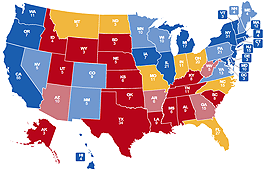
Best Picture Ever


What does this picture show? It is not just that, if trends don't markedly change in the next 48 hours, Obama will be winning the Presidency by a huge margin (touch wood), nor the more novel fact that Virginia is going blue...

It is the fact that Arizona is leaning Republican. McCain's home state isn't even a strong bastion for the candidate. Two more days...

Monday, September 15, 2008

OMG: Gas prices increase 5 cents!

While I am no longer in the US, I still try to keep up-to-date on American news. I'm not abroad for very long after all, and since we are the largest exporter of media in the world, it's actually hard to stay disconnected for long. In fact, as I've probably mentioned before, the people I meet here (albeit a highly educated, largely international, and therefore fairly biased sample) know more about American lifestyle, politics, policy, and history than many Americans. Since coming to Australia, I have definitely gained a lot of perspective as regards home; funny, how leaving a place can make you see it more clearly. The price of gas and oil: while its near-constant increasing price is hurting everyone in the US, and will more than likely hurt me when I get home, I doubt it will be nearly as high as here (about $1.50/litre) or elsewhere like Europe, where it is even higher. The minimum wage: we've just increased it to $7.50 per hour, set to occur in 2009, and Australia leaves us in the dust with a minimum wage just increased to over $15.00 an hour! And our election system: is this extended campaign period that the US is known for, which lasts over a year and racks up a bill the size of many small countries GDPs, really necessary?

While it has grown clearer that no government is perfect, and that every country has its problems, embarrassments, and controversies, we could all stand to gain a little perspective. This refreshing snippet from the Senate's Committee on Energy and Natural Resources Bipartisan Energy Summit caught my attention:

SENATOR SHELDON WHITEHOUSE (RI): Gentlemen, we’re in the middle of a near total mortgage system meltdown in this country. We have a health care system that burns 16 percent of our GDP, in which the Medicare liability alone has been estimated at $34 trillion. We’re burning $10 billion a month in Iraq.

This administration has run up $7.7 trillion in national debt, by our calculation. And there is worsening evidence every day of global warming, with worsening environmental and national security ramifications. In light of those conditions, do any of you seriously contend that drilling for more oil is the number one issue facing the American people today?

(Long silent pause during which nobody answers.)

WHITEHOUSE: No, it doesn’t seem so.

While I am certainly taking his soapbox speech with a hefty helping of salt, I do hope that our government, and what's more its people, will open their eyes and focus on what really matters.

Friday, August 29, 2008

An Election of Firsts

As nearly everyone with access to daily news has been aware of for months, this 2008 election year in the US is making history, with the first viable black candidate the country has ever seen. There has been so much hype about Barack Obama's candidacy, and so much hype about the hype that it's exhausting and a tad numbing. Being in another country, I've avoided much of it, but even all the way on the other side of the world, people keep asking me "Is this election over yet??" (Incidentally, it seems most Australians and other ex-pats I've met can hold an intelligent conversation about American politics.)

Much of the news this past week has gone to the Democratic National Convention, held in Denver. But today John McCain stole the spotlight by announcing his landmark choice for a running mate: Alaska governor Sarah Palin. At first, it seems like an astounding choice for him to have made, one no one really saw coming. However, she is young and female, and in this tough election of firsts, he made a unique choice that can rival Obama's campaign for change and better secure that elusive female vote. Not to mention her ties to the oil industry and right-wing agenda as governor of Alaska attest to the fact that she fits in well with the GOP candidate's campaign platform. No matter the outcome, McCain has ensured that this election will set a record for the United States. I just hope that this isn't all the election will come down to....

Monday, March 24, 2008

4000

The Iraq War has just claimed the life of a 4,000th soldier. This has been all over the news, just as nearly every soldier's death has been marked by overwhelming press coverage. I recently got an email from the College Democrats informing me that there will be a vigil tomorrow night to speak out against the war and honor those 4,000 dead soldiers.

Perhaps I am being callous and unfeeling, and while I do feel for those families who have lost someone due to this war, to be honest I don't particularly care. Soldiers go into the military knowing full well they could be laying down their life for the protection of the United States. Their families know this too. And while we should honor them for doing this so selflessly, I don't think it should be called a tragedy, but perhaps a mistake.

The real tragedy here is that there is one figure that is NEVER reported, and that is far more shocking: the Iraqi civilian body count. It is estimated to be between 82,394 and 89,914. Look at this news from the IBC, just yesterday:

Sunday 23 March: 74 dead

Baghdad: rocket/mortar attacks kill 19 (4 children among them); gunmen shoot 7 dead, Zafaraniya; suicide car bomber kills 5, Shula; roadside bomb kills 1, Mansour; 6 bodies.

Diyala
Abu Saida
: gunmen kill policeman and his driver.
Baquba: gunmen kill policeman; mortars kill 2; 2 children (8 and 10 years old) are blown up by bomb in playground.
Nahar Sabah: 15 (most from the same family) die in US air strike.
Muqdadiya: 2 bodies.

Kirkuk
Kirkuk: roadside bomb kills policeman.

Wassit
Kut
: 3 killed by mortars; 2 bodies.

Ninewa
Mosul
: car bombs kill 2; 4 bodies.


These aren't soldiers, these are children, civilians, workers just trying to go to their jobs. The IBC records the numbers of actual violent deaths, non-combatant only. And I am expected to feel bad for the 4,000th soldier who died doing his job, a job he or she accepted willingly? We don't have a draft in this country, our military is completely voluntary.

Am I sad to hear that 4,000 soldiers have died since 2003? Yes. Especially because I think this war has needed to be over for a while. But my reasons for wanting it to end are not just those, to put it bluntly, selfish reasons that have been bandied around for a couple of years now: the exorbitant cost, the cost of US lives, the lack of justification (now that the WMD thing has been proven false), etc. We invaded a country that was ruled by an historically vicious dictator, but their government was not much worse than any other in their region, and in many ways better than others (Sudan, North Korea anyone?). At least before the country had some semblance of stability. Now it is being torn apart by violent factions that our army doesn't seem to have any control over. Regardless of what we do, whether we leave in a year or remain for 50, the power structure of the Middle East is changed, and I don't think it will be in our favor. The only thing this war has increased are graves.

Bush should not be "express[ing] sorrow" over the US deaths, but for the over 82,000 Iraqis that have been slain and murdered as a result of the chaos we have created in their country, for the 74 killed yesterday, for the however many die tomorrow. As a reference point, the Iraqi count is more than 20 times the US loss in the last 5 years. More than 20 times. It's time our leaders get some perspective....


Thursday, March 20, 2008

The Obama Bargain

In a follow-up to my recent post on Barack Obama's speech on race, I'd like to share an article my parents sent me. It is widely known, I think, that I am a liberal daughter of extremely conservative parents. This has, for the most part, deterred me from discussing politics with them, and I'm very careful in what I do say and share; the last thing I want is to create animosity and anger between us, which comes with the territory when people with decided and opposing political views try to discuss them.

However, I sent them the video of Obama's speech anyway, in the hope that they would be affected by it and his candidacy in a greater way. I suppose I had hoped that it would begin a conversation about the election, and reveal their opinion of him more decidedly. (I am already aware of the distaste they both share for Hillary Clinton, and to some lesser extent John McCain). In response, they sent me this article, posted below. Written by Shelby Steele, a research fellow at the Hoover Institute at Stanford (i.e. a conservative policy think tank), and published in the Wall Street Journal, it takes a very pessimistic and negative view of Obama's campaign.

I was disgusted by it, to the point where I could barely finish it (so beware to the reader). The arguments made about racial iniquities in America have been around for decades, dare I say over a hundred years. These are not false, or misinformed. They have existed, and it is a stain on the country's history that African Americans and other minorities have been treated so shamefully by our system of government, and by its people. However, to use this argument against a black presidential candidate is, in my opinion, despicable. I am certain that his views, if the situation was reversed and Obama did not have the support and momentum he does, would be the same. Steele states that the only reason he is "in his position" in the race is due to his own race. That his heritage is the only reason he has gained so much popular support. He references Jesse Jackson and Al Sharpton's campaigns in the 1980s and '90s to establish connection, that like them, "Mr. Obama's run at the presidency is based more on the manipulation of white guilt than on substance". And yet, the arguments made for why they never made it were racial as well: they didn't make it because they are black, their "position" was solely due to their race. Essentially, he is arguing that black candidates for political positions like president are damned if they have support, and damned if they don't. Regardless, it is only because they are black that it is so.

Steele does not believe that Obama will win the presidency. Obama, he says, as used his race well in "bargaining" for the competitive position he has right now, with his promise of appeasing the "hunger for white innocence" and ending black inferiority. He "hopes to ascend [to power] on the back of [white] gratitude", but ultimately will not prevail. To thus simplify what has so far been an excellent and competitive political campaign in those "black and white" terms belittles Obama in the most offensive way possible. To Steele, he is not talented, appealing, intelligent, or wise, but simply a sly black man vying for the favor of a racist white America.

The historic nature of his candidacy is what is most attractive about him, Steele states. However, he overlooks a crucial point, one that I also find offensive and disparaging. Hillary Clinton is also an historic candidate, and yet the fact that she is a woman running in a country where gender discrimination is very real is never given a thought. She is dumped unceremoniously with the rest of the 2008 candidates because she is white. Apparently to Steele, the nuances of race are the only ones that matter.

In one aspect I do concede to Steele: Obama is on occasion lacking in what he calls a "galvanizing political idea". He can be rather vague about his tangible plans for acting upon the changes he seeks to make, and is sometimes even ambiguous about what those changes should be. However, I would like to believe that the reason he is supported despite these failings is because of his incredible ability to inspire us as Americans, not as white Americans or as black Americans or as Asian or Hispanic or Native Americans. There is a choice we make, to remain rooted to the past as Steele seems to be, with his negativity and pessimism towards the motivations of our nation's citizens (not just in this article, but in his many published works), or to embrace the potential of a future where our differences unite us, not divide us. We cannot hope to solve the problems of racial injustice in this country when we still allow ourselves to blame each other for it. We need to reconcile those problems, not chain ourselves to them.

Barack Obama has never been appealing to me because he is black, in just the same way as Hillary Clinton is not because she is a woman. I base my support as purely as I can on the merit of each candidacy. That is how I feel Obama has run his campaign thus far, addressing race only when it was completely necessary. Maybe I'm too much of an idealist, but I feel Steele is sorely mistaken in his assessment of Obama's campaign, and hope to see him proven wrong.

The Obama Bargain

By SHELBY STEELE
March 18, 2008; Page A23

Geraldine Ferraro may have had sinister motives when she said that Barack Obama would not be "in his position" as a frontrunner but for his race. Possibly she was acting as Hillary Clinton's surrogate. Or maybe she was simply befuddled by this new reality -- in which blackness could constitute a political advantage.

But whatever her motives, she was right: "If Obama was a white man, he would not be in this position." Barack Obama is, of course, a very talented politician with a first-rate political organization at his back. But it does not detract from his merit to say that his race is also a large part of his prominence. And it is undeniable that something extremely powerful in the body politic, a force quite apart from the man himself, has pulled Obama forward. This force is about race and nothing else.

The novelty of Barack Obama is more his cross-racial appeal than his talent. Jesse Jackson displayed considerable political talent in his presidential runs back in the 1980s. But there was a distinct limit to his white support. Mr. Obama's broad appeal to whites makes him the first plausible black presidential candidate in American history. And it was Mr. Obama's genius to understand this. Though he likes to claim that his race was a liability to be overcome, he also surely knew that his race could give him just the edge he needed -- an edge that would never be available to a white, not even a white woman.

How to turn one's blackness to advantage?

The answer is that one "bargains." Bargaining is a mask that blacks can wear in the American mainstream, one that enables them to put whites at their ease. This mask diffuses the anxiety that goes along with being white in a multiracial society. Bargainers make the subliminal promise to whites not to shame them with America's history of racism, on the condition that they will not hold the bargainer's race against him. And whites love this bargain -- and feel affection for the bargainer -- because it gives them racial innocence in a society where whites live under constant threat of being stigmatized as racist. So the bargainer presents himself as an opportunity for whites to experience racial innocence.

This is how Mr. Obama has turned his blackness into his great political advantage, and also into a kind of personal charisma. Bargainers are conduits of white innocence, and they are as popular as the need for white innocence is strong. Mr. Obama's extraordinary dash to the forefront of American politics is less a measure of the man than of the hunger in white America for racial innocence.

His actual policy positions are little more than Democratic Party boilerplate and hardly a tick different from Hillary's positions. He espouses no galvanizing political idea. He is unable to say what he means by "change" or "hope" or "the future." And he has failed to say how he would actually be a "unifier." By the evidence of his slight political record (130 "present" votes in the Illinois state legislature, little achievement in the U.S. Senate) Barack Obama stacks up as something of a mediocrity. None of this matters much.

Race helps Mr. Obama in another way -- it lifts his political campaign to the level of allegory, making it the stuff of a far higher drama than budget deficits and education reform. His dark skin, with its powerful evocations of America's tortured racial past, frames the political contest as a morality play. Will his victory mean America's redemption from its racist past? Will his defeat show an America morally unevolved? Is his campaign a story of black overcoming, an echo of the civil rights movement? Or is it a passing-of-the-torch story, of one generation displacing another?

Because he is black, there is a sense that profound questions stand to be resolved in the unfolding of his political destiny. And, as the Clintons have discovered, it is hard in the real world to run against a candidate of destiny. For many Americans -- black and white -- Barack Obama is simply too good (and too rare) an opportunity to pass up. For whites, here is the opportunity to document their deliverance from the shames of their forbearers. And for blacks, here is the chance to document the end of inferiority. So the Clintons have found themselves running more against America's very highest possibilities than against a man. And the press, normally happy to dispel every political pretension, has all but quivered before Mr. Obama. They, too, have feared being on the wrong side of destiny.

And yet, in the end, Barack Obama's candidacy is not qualitatively different from Al Sharpton's or Jesse Jackson's. Like these more irascible of his forbearers, Mr. Obama's run at the presidency is based more on the manipulation of white guilt than on substance. Messrs. Sharpton and Jackson were "challengers," not bargainers. They intimidated whites and demanded, in the name of historical justice, that they be brought forward. Mr. Obama flatters whites, grants them racial innocence, and hopes to ascend on the back of their gratitude. Two sides of the same coin.

But bargainers have an Achilles heel. They succeed as conduits of white innocence only as long as they are largely invisible as complex human beings. They hope to become icons that can be identified with rather than seen, and their individual complexity gets in the way of this. So bargainers are always laboring to stay invisible. (We don't know the real politics or convictions of Tiger Woods or Michael Jordan or Oprah Winfrey, bargainers all.) Mr. Obama has said of himself, "I serve as a blank screen on which people of vastly different political stripes project their own views . . ." And so, human visibility is Mr. Obama's Achilles heel. If we see the real man, his contradictions and bents of character, he will be ruined as an icon, as a "blank screen."

Thus, nothing could be more dangerous to Mr. Obama's political aspirations than the revelation that he, the son of a white woman, sat Sunday after Sunday -- for 20 years -- in an Afrocentric, black nationalist church in which his own mother, not to mention other whites, could never feel comfortable. His pastor, Rev. Jeremiah Wright, is a challenger who goes far past Al Sharpton and Jesse Jackson in his anti-American outrage ("God damn America").

How does one "transcend" race in this church? The fact is that Barack Obama has fellow-traveled with a hate-filled, anti-American black nationalism all his adult life, failing to stand and challenge an ideology that would have no place for his own mother. And what portent of presidential judgment is it to have exposed his two daughters for their entire lives to what is, at the very least, a subtext of anti-white vitriol?

What could he have been thinking? Of course he wasn't thinking. He was driven by insecurity, by a need to "be black" despite his biracial background. And so fellow-traveling with a little race hatred seemed a small price to pay for a more secure racial identity. And anyway, wasn't this hatred more rhetorical than real?

But now the floodlight of a presidential campaign has trained on this usually hidden corner of contemporary black life: a mindless indulgence in a rhetorical anti-Americanism as a way of bonding and of asserting one's blackness. Yet Jeremiah Wright, splashed across America's television screens, has shown us that there is no real difference between rhetorical hatred and real hatred.

No matter his ultimate political fate, there is already enough pathos in Barack Obama to make him a cautionary tale. His public persona thrives on a manipulation of whites (bargaining), and his private sense of racial identity demands both self-betrayal and duplicity. His is the story of a man who flew so high, yet neglected to become himself.

Mr. Steele, a research fellow at Stanford University's Hoover Institution and the author of "A Bound Man: Why We Are Excited About Obama and Why He Can't Win" (Free Press, 2007).
Tuesday, March 18, 2008

Speechless


Obama's speech will go down in history as one of the best modern speeches about America's ongoing racial divide and the failure to address the roots of it.
- Dallas Morning News

For a 40 minute speech, my mind didn't wander. I watched it mesmerized by his power to capture the essence of a complex and controversial subject. He stated in more eloquent terms everything I had previously thought about the racial divide in America. He just gets it. And what's more, he gets how to convey it. He managed to take a divisive issue and talk about it rationally, calmly, and thoroughly. Notice how the crowd is silent for nearly the duration of the speech. His speeches make you speechless, and that is why he needs to be president. If he can connect with Americans as he does so well, unite them in the way he has his entire campaign, maybe we have a chance at solving the problems that plague us. Maybe we have a chance at moving the country forward. Maybe we finally have a chance.

Tuesday, February 26, 2008

Nutcases

There is a tragic flaw in our precious Constitution, and I don't know what can be done to fix it. This is it: Only nut cases want to be president.
- Kurt Vonnegut

I don't know if you watched the last Democratic debate tonight, but while it rehashed many of the same sticking points each candidate has with one another, and went over the nuances of the health care packages of both ad nauseam, it was good to see them talk yet again. And once more, in my opinion, Obama comes off as the reasoned and gracious debater, if a bit rough around the edges, while Clinton's scathing sarcasm and pointed remarks about Obama did more to damage her image than his.

So be on the lookout next Tuesday, because if Hillary doesn't win Ohio and Texas, it could be over for her....

Wednesday, January 16, 2008

Debate

Tonight was the Las Vegas Democratic debate between the three remaining candidates of the Democratic Party, Clinton, Edwards, and Obama. It was a great way to understand more of their opinions on the big issues like the economy, the environment, the military, welfare, health care, etc. Shrewd viewers can even sift through the rhetoric to uncover the candidates' true opinions, and the weaknesses in their views. I recommend looking at it if you didn't watch it tonight; I'm sure it can be found on youtube or some such.

That being said, my first impressions seemed to gravitate again to Barack Obama, as it has been more and more since he first announced his candidacy. He seems to have viewpoints and plans I really agree with, and truly understand the reality of many complex situations. Edwards, by contrast, is more extreme than the other two, and his goals seem too infeasible when grouped together. Too much money going out to programs (which are good ideas on paper) but no real way to finance them realistically. Hillary Clinton has always rubbed me the wrong way, and has never seemed genuine. Her overconfidence is something that I find a negative trait rather than positive.

Unfortunately, the pundits analyzing the debate after the fact seem to think that Hillary came off really strong and seems the most viable candidate at the moment, which I didn't really see at the time. I understand how they came to that position now, but it all seems like they were judging her rhetoric and confidence rather than the actual content of her answers, which honestly weren't all that compelling (though now I might be unintentionally biased). She seems to be trying to undermine the Obama campaign by aligning her views with him, and not the other way around, and playing up her experience, which is nothing to sniff at. However, I think there is something to be said for new blood, and all the experience in the world doesn't necessarily mean that you are a better fit for the presidency if your ideas and presence in politics are stale and unexciting.

Tuesday, May 01, 2007

The Hypocrisy of California

California is almost idyllic for many people. It's beautiful beaches, sun-drenched mountains, amazing cities, and great opportunities. However, how many people know of the precarious foundations this state is built on?

In the course of my studies we have analyzed California every which way, from urban policy and economic innovation, investigating the reasons behind businesses' success, and also the many environmental advancements that are initiated there. The rest of the country often follows in their legislative and regulatory footsteps. While the state could now be considered a spearhead of the environmental movement, its history and many of its current policies are far from preservationist.

The state is one of the highest food-producing states in the country. Most of our fruits, vegetables, meats, or milk products come from California. Yet, if you've ever driven through any part of the state, you have to wonder, WHAT? The entire landscape is a mixture of arid desert, semidesert, or dry plain. One of the many attractions of California is the gorgeous weather, marked by blue sunny skies that are omnipresent. They have two seasons, the rainy and the other, and from March to November the entire state gets little to no rain at all. So, how do they do it, you wonder? Well, I'll tell you (summarizing of course).

During the Great Depression, Roosevelt began many public works projects to employ out of work men. The state of California was a very different place at that point in time, the cities much smaller, the land much drier, and devastating floods countering long droughts made farming difficult, to say the least. But with modern technologies emerging, farmers began to harness the land's natural resources, including a huge aquifer under the plains left from the last Ice Age, untouched until that point. They also decided to harness some of the water from rivers and divert it, building large dams and aqueducts to channel the water to "where it was needed". The government began setting aside money for these irrigation building projects, and water was dispersed to the farms, cheaply and efficiently. In a way, it was better than relying on natural methods of getting water to plants like rainfall, because it could be regulated on the time schedule best suited for the crop to prosper.

This changed the landscape of California from dry plain to blooming field. When you drive through the Central Valley of California now, you can see miles of lush growth, oranges, apples, garlic, even lettuce. But this change is inherently unsustainable. The water from the underground aquifers is being depleted but not replenished, and the water that is diverted from other areas is not enough to sustain the area for an indefinite period of time. So much of the water from these rivers has been diverted to other areas that their routes have been fundamentally changed. The Colorado River no longer runs into Mexico, and is now just a dry riverbed, disconcerting to a country that is in desperate need of drinkable water.

Californians are farming a desert, and many people don't even realize it. Unless you knew about the grand schemes for getting water to the area, it would just look like an idyllic farmland, sunny and lush for mile upon mile. But someday, maybe even in my lifetime, we could see a fundamental shift, if there isn't enough water to go around. Policy-makers will have to come up with new ideas of sustaining the current land-use policies, but none of them will be permanent, and eventually the land will revert back to desert. Bad news for the farmers and the millions of people who rely on the region's agricultural productivity.

This revelation made me wonder how California could be an advocate for so much environmental change and yet allow this to keep happening. It's part of the hypocrisy of the state, which is mimicked throughout the rest of the country: focus on certain issues while ignoring others. It's a matter of convenience; air pollution is a problem for humans, directly detrimental to one's health, and should therefore be dealt with. However, farming makes a huge positive impact on the population, both in terms of the revenue it brings in and the product it sells. It is not economically "responsible" to create restrictions that would reduce the productivity of this breadbasket. However, sooner or later something catastrophic will occur that will lead to a lot of destruction, both economic and environmental. Something needs to be done, but I don't see any meaningful change likely for just the reasons I have listed. It will take a more drastic wake-up call than environmental theories of the future and threats of potential major destruction to incite people to change. And by then it will probably be too late.


As a caveat: this is not to say that California is alone in its hypocrisy. Most states in the US have similar stories they could share, harrowing tales of environmental disasters covered up quietly. In California, however, these problems are seen clearly, and with their almost unparalleled focus on environmental issues, I believe the state has more of a burden to explain itself.

Tuesday, April 17, 2007

And this is the kind of ignorance I hope to remedy...

It is sad that in these times, people could believe things like this are true. No matter how comic, it reveals an appalling lack of sheer common sense. It did give me a chuckle though. ^_^